How to include the FIFA World Cup into ESL Classroom Activities
Whether you call it soccer or football, the FIFA World Cup is a sporting event that captures the attention of millions around the globe. It’s known as “the world game” for a reason because it has the ability to unite people from different cultures, backgrounds, and nations.
During the tournament, entire countries come together to support their national teams, creating a sense of community and excitement. From dramatic goals to unforgettable upsets, the World Cup brings people together and celebrates the universal language of sport.
Learning Objectives
- Discuss soccer/football and the World Cup confidently.
- Use sports-related vocabulary.
- Talk about past World Cup experiences.
- Make predictions about future matches.
- Express opinions and preferences.
1. Warm-Up
Discussion Questions
Put students in pairs or small groups.
1. Do you like football/soccer?
2. Which team do you support?
3. Have you ever watched a World Cup match?
4. Which country do you think has the best team?
5. Why is the World Cup popular around the world?
Quick Poll / Ask students:
- Which country will win the World Cup?
- Who is your favorite player?
2. Vocabulary Introduction
Teach these key words:
Word / Meaning
- tournament / a competition with many teams
- goalkeeper / player who protects the goal
- striker / player who scores goals
- referee / official who controls the game
- penalty / special kick after a foul
- supporter / fan or person who supports a team
- champion / winner
- draw / game ending with equal scores
- score a goal / put the ball in the net
- knockout stage / stage where losing teams are eliminated
3. Idioms
Match the Correct Words / Meanings:
1. Dark horse
2. Underdog
3. Level the score
4. Comeback
5. On the ball
A. A team that is expected to lose
B. To recover from a difficult situation
C. A surprising team that may do well
D. To make the score equal
E. Alert and performing well
Complete the sentences:
Many people think Morocco could be a __________ in the tournament.
Australia is the __________ against Brazil.
The striker scored in the 89th minute to __________.
After losing two games, the team made a great __________.
He was _________ all game. (also used in work/life contexts)
4. Reading Activity
The FIFA World Cup
The FIFA World Cup is the biggest football tournament in the world. It takes place every four years and brings together national teams from many countries. Millions of people watch the matches on television and online.
Teams compete in a group stage before entering the knockout stage. The winning team becomes world champion. Famous countries such as Brazil, Argentina, Germany, and France have won the tournament before.
Comprehension Questions:
1. How often is the World Cup held?
2. What happens after the group stage?
3. Why is the tournament famous?
4. Name two countries mentioned in the text.
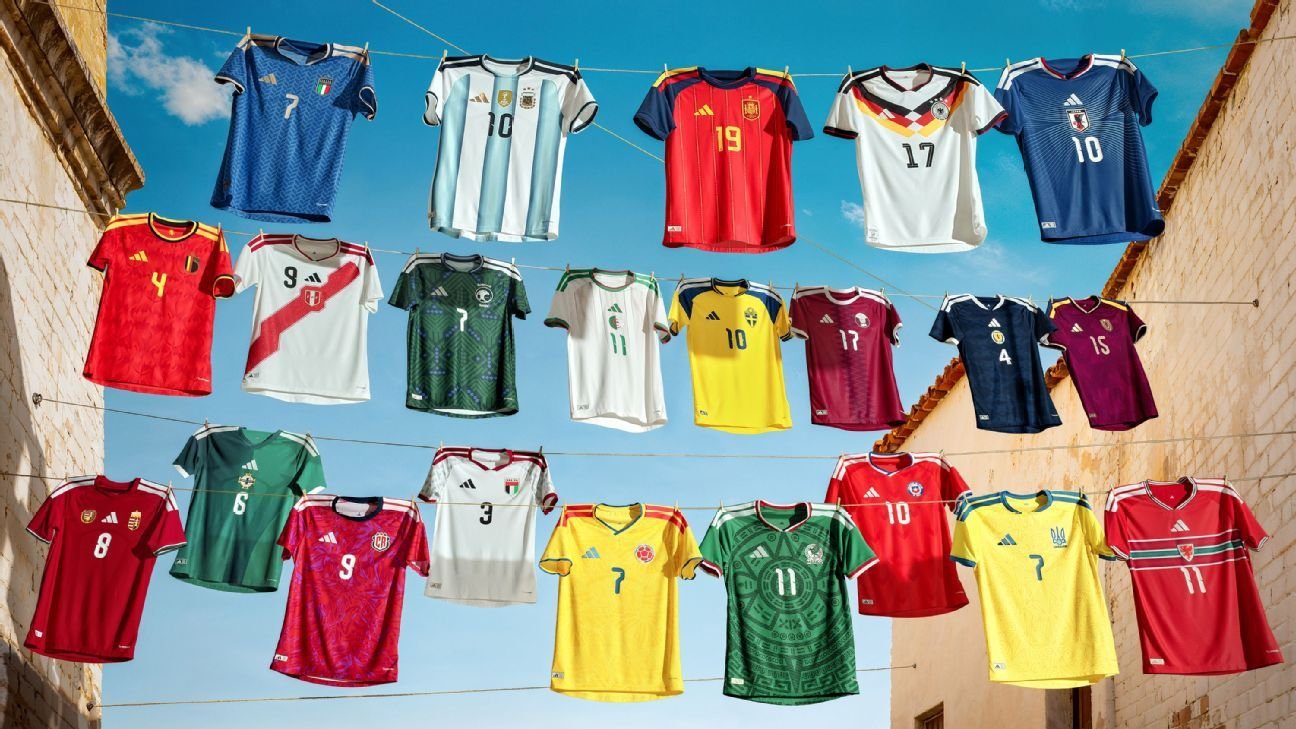
5. Activity: Match the Jersey to the Country
Ask students:
- Match the jerseys in the picture to the correct country.
- Do you own a football/soccer jersey? If yes, what jersey?
- Which national team has the best jersey?
- Should teams change traditional colours?
6. Grammar Focus: Future Predictions
Examples:
Brazil will win the tournament.
England might reach the semi-finals.
Argentina could become champions.
Australia might surprise many fans and reach the quarter-finals.
France will probably score a lot of goals during the tournament.
Complete:
Spain _____ win the final.
My team _____ score many goals.
The next World Cup champion _____ be _____.
Australia _____ reach the knockout stage.
Brazil _____ win all of its group matches.
7. Speaking Activity: World Cup Predictions
Put students into pairs and discuss:
- Which team will win the World Cup?
- Which player will score the most goals?
- Which team might surprise everyone?
Useful Phrases:
- I think _____ will win because…..
- In my opinion…..
- They have a strong team because…..
- I predict that…..
- They might reach the final…..
8. Speaking Extension for Higher-Level Students
“Is the FIFA World Cup more important than the Olympic Games?”
– Students prepare arguments and rebuttals before discussing.
– Go around the class to elicit answers from each student.
– This discussion usually generates a lot of speaking because most learners have some opinion about football/soccer or the Olympics, even if they aren’t dedicated fans.